Product
Trellis
The same AI, working on the system you already run. Trellis reads your live data, works the exceptions overnight, and writes back through your existing platform. Your billing, your integrations and your month end do not move.
Plenty of good operators have good reasons to keep what they have.
You finished an implementation eighteen months ago and nobody wants to do that again. You are a group holding two dozen instances and standardizing them is its own project. You are mid-season. You have term left on an agreement. Or you would simply rather see the numbers proved on your own data before anyone talks about replacing anything.
All of those are reasonable, and none of them should cost you the benefit. Trellis connects to what you run and goes to work on the same data your reports already use.
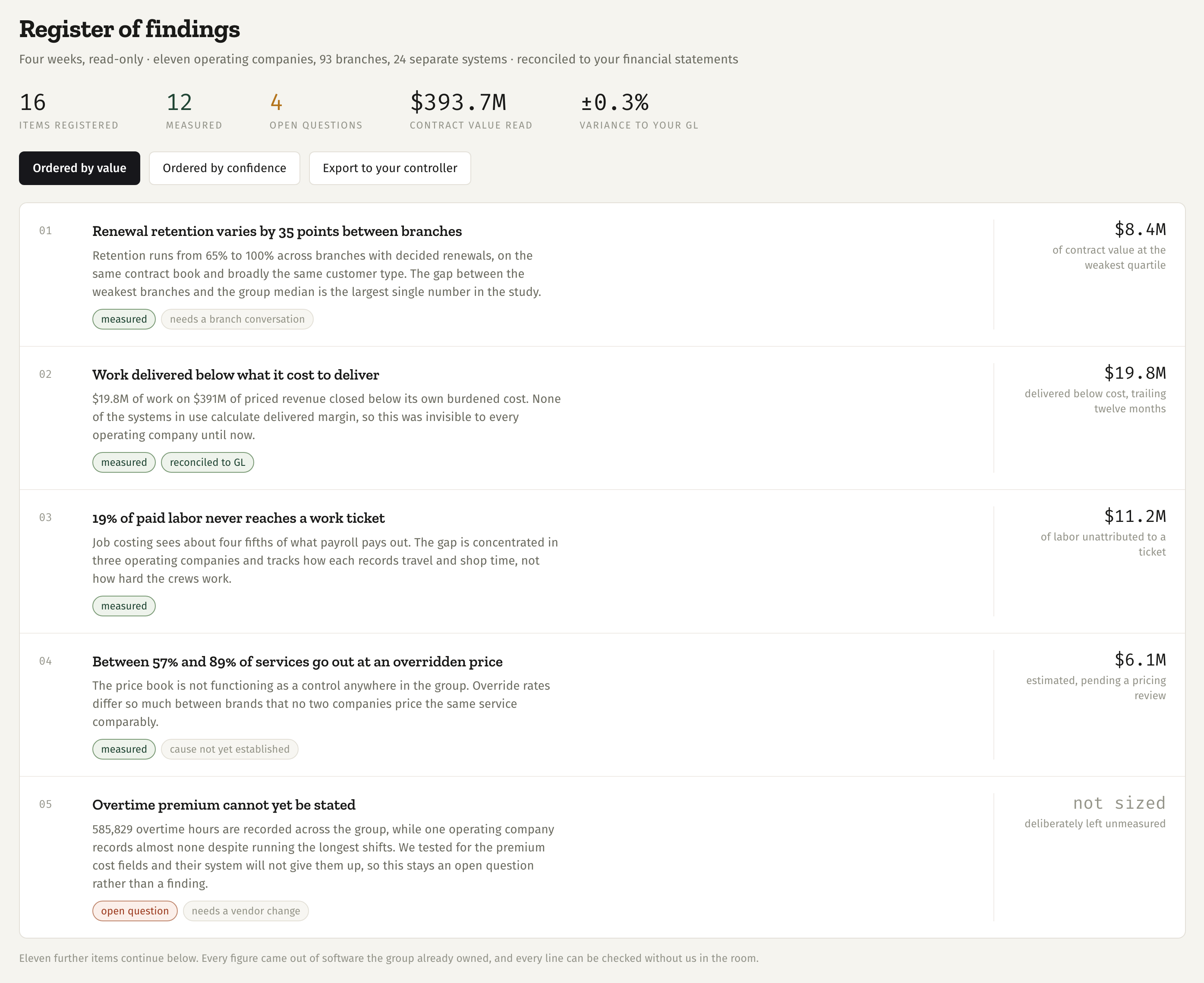
The register on the evidence page was produced exactly this way, across 24 separate systems, without changing anything in any of them.
Works with
- Aspire
- LMN
- SingleOps
- Include (Asset)
- Real Green
- BOSS LM
- ServiceTitan and other field service platforms
- Your data warehouse, if you already have one
Groups running several systems at once are the normal case here, not the hard case. Trellis reads across all of them and reports at group, company, brand and branch level. More on how this works for rollups.
What you get in the first month.
Before you have changed a single thing about how you operate.
We connect to your system, read a season of history, and reconcile our totals against your own financials before we claim anything at all. Then you get a plain register of what is actually happening in your business.
If it finds nothing worth acting on, we will say so and you will owe us nothing further. It has not happened yet, but the offer is real.
- A list of opportunities, each one sized from your own data
- A confidence rating on every item, separating what we found from what we are still asking
- Our figures reconciled to your financial statements
- The list ordered by what it is worth, not by what is easy
- One named agent and a target for the first thing we would turn on
How it rolls out
Nothing gets written back to your system until you have seen it work.
It reads only
We connect, take in a season of history, and prove our totals against your financials. You get the register of findings, sized and rated. Nothing is written back to anything.
One agent, proposing
Pick the finding worth the most. We turn on the one agent that addresses it, in one or two branches, and every proposal it makes is approved by a person. How often you approve is the number we both watch.
Widen carefully
More branches, more agents, and more independence only where the approval record has earned it. You can put any agent back to just watching at any time, branch by branch.
What it is allowed to touch is your decision.
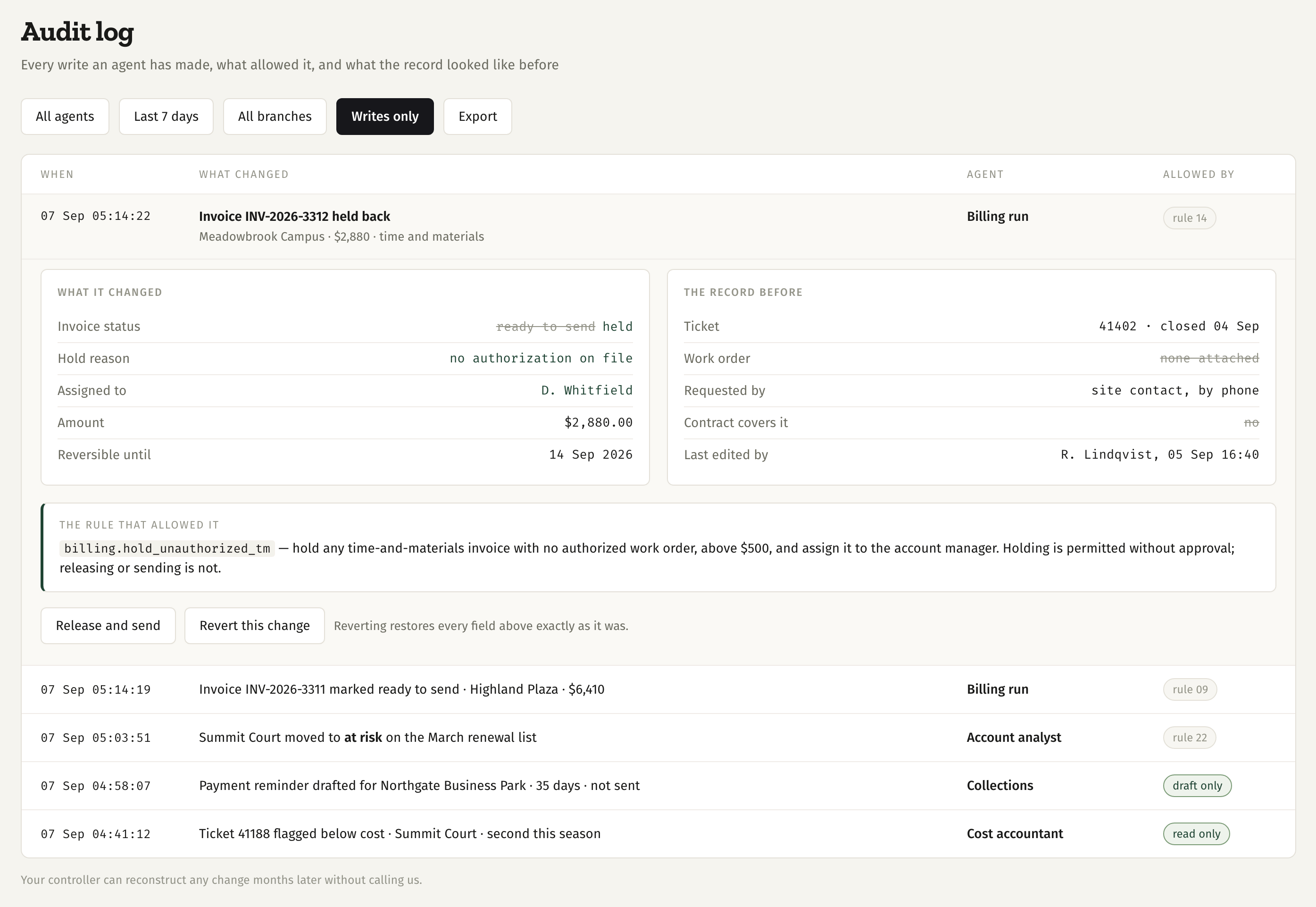
You set what each agent may change: which kinds of record, which branches, which dollar limits, which hours of the day. Anything outside those limits stops being an action and becomes a proposal.
Every change is logged and reversible. The log shows which agent acted, what it changed, which rule allowed it and what the record looked like beforehand. Your controller can reconstruct any change months later without calling us.
The thing your system cannot work out on its own
What a job actually cost to deliver is the clearest example. None of the platforms in this category calculate it, which is why work sold below its own cost stays invisible until the season is over.
If you do decide to move later
Moving to Canopy is a season, not a saga. We bring across properties, contracts, price book, estimating history and closed tickets, and run both systems side by side for a full billing cycle before anyone commits. Your agents, your limits and your approval history come with you.