AI for commercial landscape operations
Your software knows everything about your business. It has never once done anything about it.
Every proposal, route, renewal and invoice you have ever produced is sitting in there. ArborSoft goes to work on it overnight. You come in to next week's routes planned, your invoices assembled, and the accounts that are slipping already flagged.
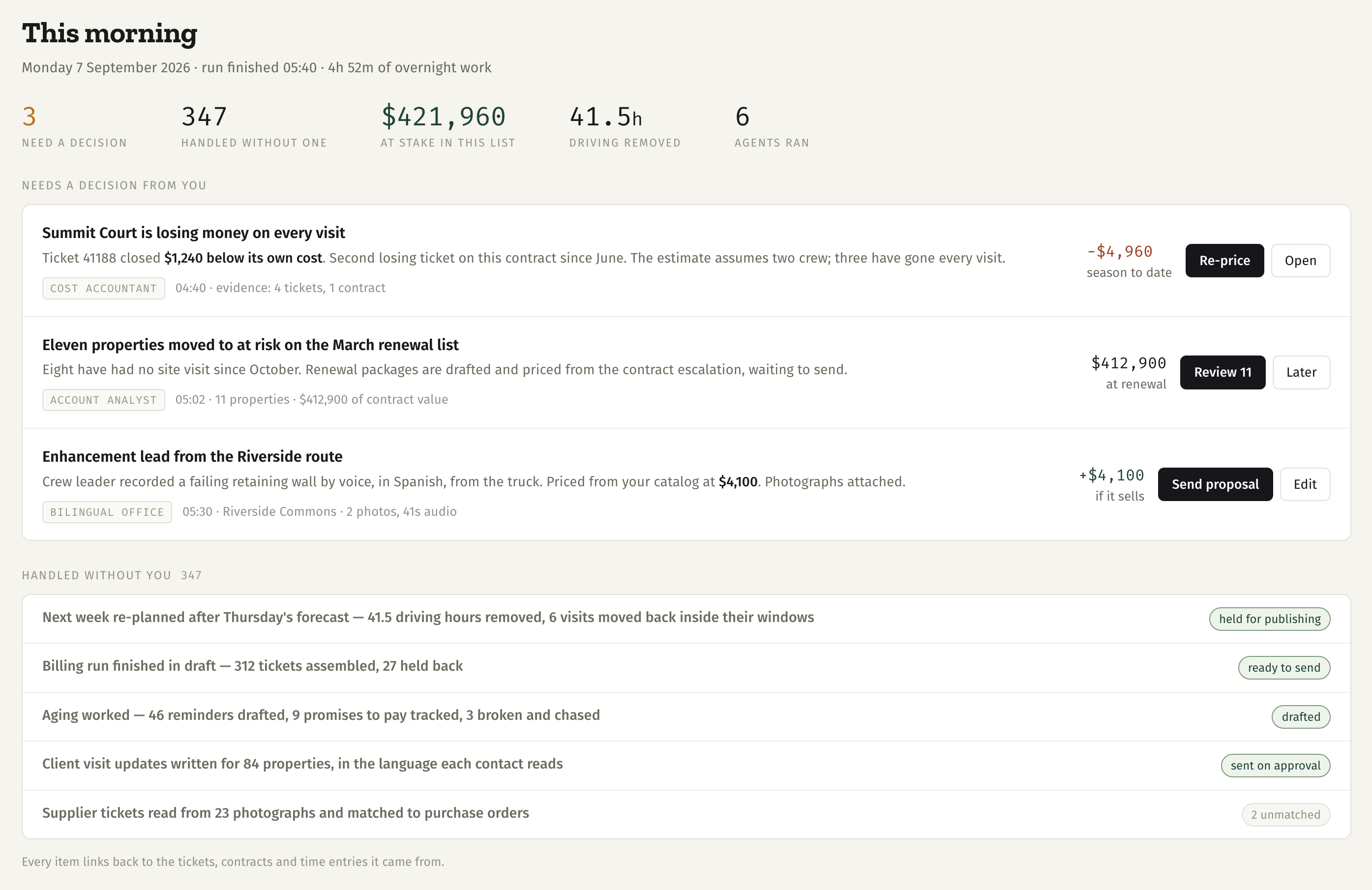
- 04:12 Next week re-planned after Thursday's forecast. 41.5 driving hours removed, 6 visits moved back inside the windows you promised. Nothing published. What changed against what the field already saw is waiting for you.
- 04:40 Ticket 41188 closed $1,240 below its own cost. Second losing ticket on this contract since June. The estimate assumes two crew. Three have been going every visit.
- 05:02 Eleven properties moved to at risk on the March renewal list. Eight have had no site visit since October. Renewal packages drafted, priced from the contract escalation.
- 05:15 Billing run finished in draft. 312 tickets assembled, 27 held back. Nine are time and materials with nobody's authorization on them. The rest are disputes past terms.
- 05:30 Crew note from the Riverside route, spoken in Spanish from the truck, written up as an enhancement lead. $4,100 priced from your catalog.
You are not going to fix these by working harder.
Every number below came out of software the operator already owned. It was all sitting right there. Nobody had the hours to go and find it.
Measured across one multi-brand group: eleven operating companies, 93 branches, $393.7M of contract value and 47,097 crew-weeks of production data, read out of 24 separate systems. Every figure came from software they already ran. The full register is here.
This is the part your current system was never going to do.
Your software was built to record what happened, and it is good at that. But finding the one ticket out of 312 that lost $1,240 — every morning, on every branch, before it becomes a pattern — is not a job a person can hold down. A report will not do it either, because somebody still has to open the report.
It is reading, comparing and chasing, forever. That is exactly the kind of work AI is good at, and it is the first thing in twenty years that can actually take it off your desk.
Where to start with AI
Everyone tells you to use AI. Nobody tells you where to start.
You do not need an AI strategy. You need next week's routes fixed, the enhancement your crew spotted written up, and your billing out the door on Friday.
So we did not build you a chatbot to go and ask questions of. We built agents. Each one does a single job you would otherwise hand to a person. It works overnight on your real data, and it shows you what it did in the morning.
Each one does a single job
One plans routes. One works your aging. One reads what the crews recorded and writes the proposal. You do not prompt them, and there is nothing new for you or your people to learn.
They work while you are closed
Everything runs overnight against your live data. By the time you open your laptop the work is done, drafted and sitting in a list, with the reasoning attached to each one.
They ask before anything matters
Nothing reaches a crew, a customer or an invoice without a person saying yes — until you decide otherwise, one job at a time, at your pace.
What actually changes on Monday.
Not a dashboard, and not a report you have to go and read. The same week you already have, with the parts nobody has time for already done.
It rains Thursday.
Your ops manager spends the afternoon on the phone rebuilding next week, and two crews still turn up at the wrong property.
Next week is already re-planned.
Re-sequenced overnight against drive time, gate hours and the visits you promised in the contract. You approve it with one click. Nothing reaches a crew until you do.
A crew leader spots a failing retaining wall.
He mentions it to someone back at the shop. It never gets written down, and the client hires somebody else to fix it.
It is a priced proposal by that afternoon.
He says it into his phone in Spanish from the truck. Your own catalog prices it at $4,100 and it lands on the account manager's list.
Billing takes three days.
The tickets nobody authorized go out anyway, or sit for a month while someone works out whether they should.
The invoices are assembled overnight.
The clean ones are ready to send. The 27 that are not come to you as a short list, with the dollars attached and the reason each one is being held.
You find out an account is leaving when the letter arrives.
By then it has been drifting since summer, and there is nothing left to do about it.
You hear in July, while you can still fix it.
One missed visit in June, a complaint nobody closed out, and eight months still to run before renewal. Long enough to save the account rather than replace it.
You find out a contract lost money at year end.
If you find out at all.
The second losing ticket comes to you the morning it happens.
With the reason attached: the estimate assumes two crew, and three have been going every visit. If there is a third, your branch manager hears about it too.
The rest of the week works the same way.
Every one of these runs overnight, drafts what it can, and brings you only the part that needs a decision from a person.
- Client updates and seasonal notes, written from what the crew actually recorded
- Inbound requests measured, priced and drafted before lunch
- Renewal packages assembled 120 days out, at the escalation your contract allows
- The aging worked every morning by who the customer is, not by days outstanding
- Purchase orders matched against what actually turned up on site
- Crew hours reconciled to the ticket they were supposed to land on
- Subcontractor invoices checked against the work that was authorized
- Snow events called out against the trigger depths written into the contract
It earns its way up, one job at a time.
No operator hands next season's schedule to software on day one, and no software should ask them to. Every agent starts out just watching, and only moves up when it has been right often enough to be boring.
There are five levels in all, and you set them job by job and branch by branch. See what stops each one going wrong
It watches
It runs against your live data and records what it would have done. You compare that to what actually happened. It changes nothing, and you get a real number at the end of it.
It proposes
It drafts the change and shows you why, and a person approves it. Every approval is logged, so you can see exactly where it has earned trust and where it has not.
It acts
Inside limits you set, it goes ahead and tells you afterwards. Anything outside those limits still comes back to a person, every time.
The same problem arrives in two shapes.
A single company and an eleven-brand group both hold more in their data than anyone has time to act on. What differs is the reason why.
If you run one company
A group with 90 branches can afford a dispatcher who only sequences routes, an analyst who costs jobs every week, and a clerk who works the aging every morning. You have the same problems and one person to solve them, usually after the trucks are back.
That is not a talent gap. It is overhead you cannot spread across 90 branches, and the work those roles do is mostly reading, comparing and chasing.
If you run several
Every acquisition arrives with its own system, its own price book, its own idea of a billable hour and its own branding. Comparing a branch in one brand to a branch in another takes a month of manual work, and standardizing everything is a three-year answer to a this-quarter question.
The agents do not need your systems to match. They only need to be able to read them. The local brands stay exactly as the customers know them.
Two ways to get there
Most operators are not ready to replace the system that runs their billing. They should not have to wait for the benefit.
Canopy
The whole operation, rebuilt
Everything from the customer record to the invoice: estimating, scheduling, crew time, purchasing, job costing and collections. One system, built from the ground up to run this way.
- Everything your current system does
- Routes planned by math, not by a computer taking a guess
- Your crews can talk to it, in English or Spanish, from the truck
- Rent it from us, or buy it outright and run it yourself
- We move your data, and run both systems side by side until you are sure
Trellis
The same AI, on the system you already run
The same agents, working on top of your current platform. Trellis reads your data, works the exceptions overnight, and writes back into the system you already trust. Nothing gets ripped out.
- Works with the major landscape and field service platforms
- Reads every company in your group at once, not one at a time
- Read-only for the first four weeks, so the numbers get proved first
- Value delivered in weeks, not in a replacement cycle
We do not open with a demo. We open with your own data, and a number you can check against your general ledger.
Start with the diagnostic
Give us read access to a season of your data. Four weeks later you get a plain register of what is actually happening in your operation: what it is worth, how confident we are in it, and what to do about it first.
Some of it will be a finding. Some of it will be an open question. We tell you which is which, because a number you cannot check yourself is worth nothing to you.